Avenue
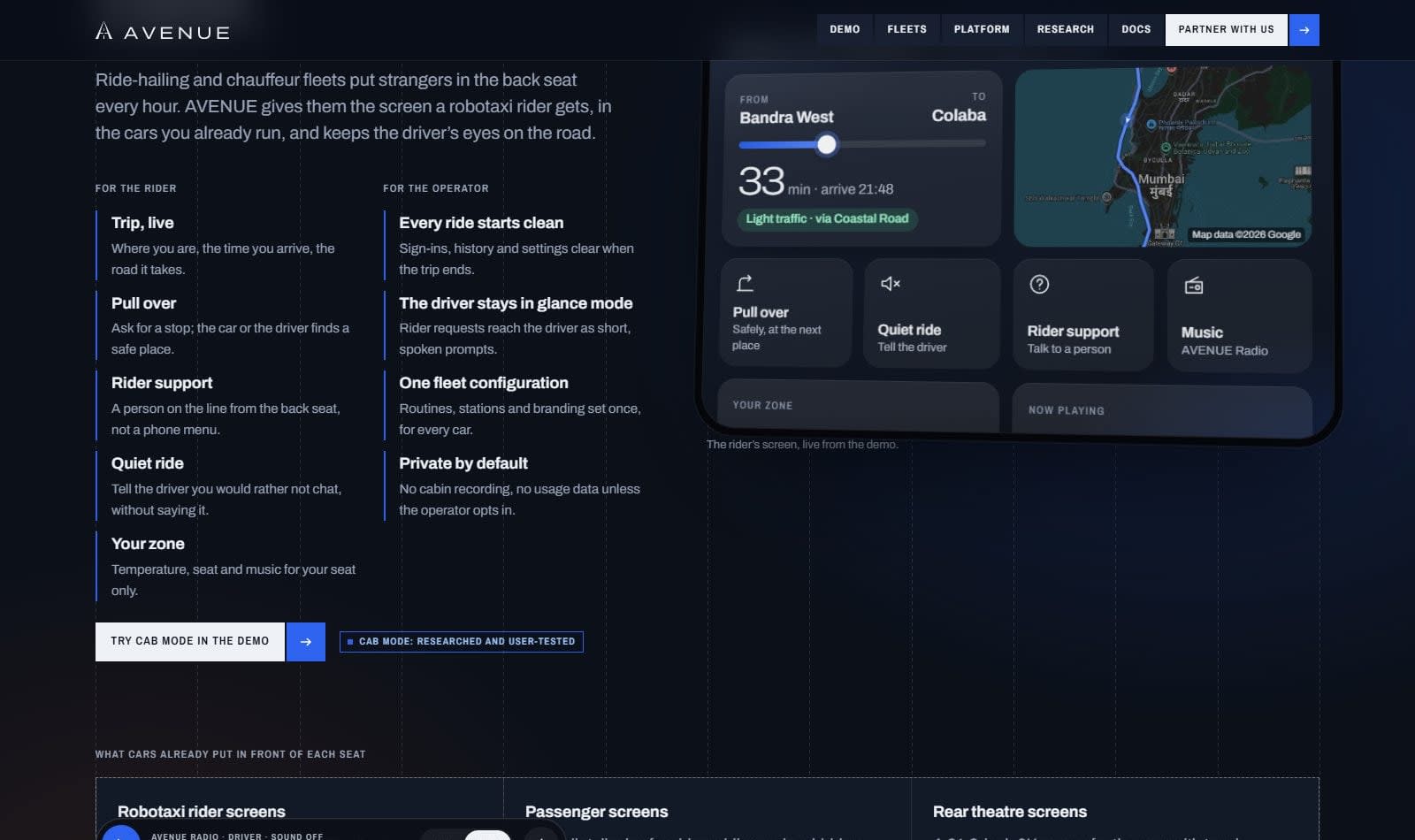
Every seat gets a first-class screen, and the screens work together. AVENUE is a cabin system for the whole car: the driver, the co-pilot and each rear passenger, on one shared system.
- Type
- Own product
- Status
- Version 0.2, open for partners
- Our role
- Research, product design, design system and build
- Services

- 4
- Seats, one shared system
- 25
- Requirement cards from the research
- +1.4
- Overall experience, out of 5 Version 2 against version 1
- ≤2 s
- Per glance on the driver's screen The rule we design to
01
The problem
Most cabins now carry several displays, each designed on its own. In the back, where people sit longest, the screen rarely matches the one up front, so passengers reach for their own tablets.
AVENUE began as a rear-seat system for luxury cars and grew into a system for the whole car: one state for the route, media, climate and SOS, shown on every screen in the form that suits that seat.

02
Research to requirements
We interviewed rear-seat passengers, ran desk research and competitive benchmarking, and mapped what people think, feel, say and do on a long car journey. The finding that set the brief: in the back, passengers are bored and fall back on their own devices.
The research became twenty-five Volere requirement cards, A to Y, each with a rationale, a fit criterion and its source, prioritised with MoSCoW. A home screen branches into journey, content, car controls, features, quick widgets and settings, with task flows for getting information, entertainment and utilities on the move.

03
One system, four seats
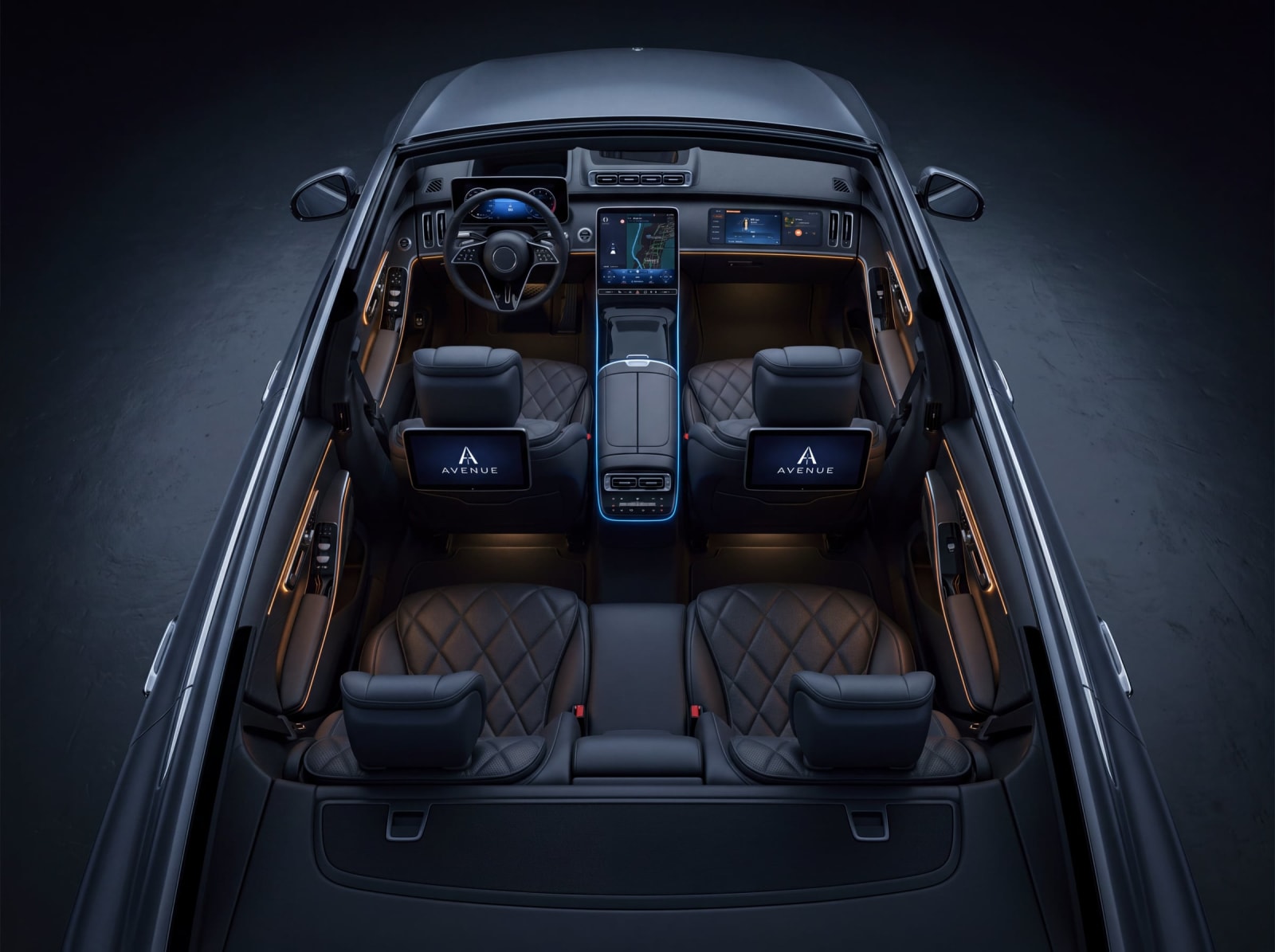
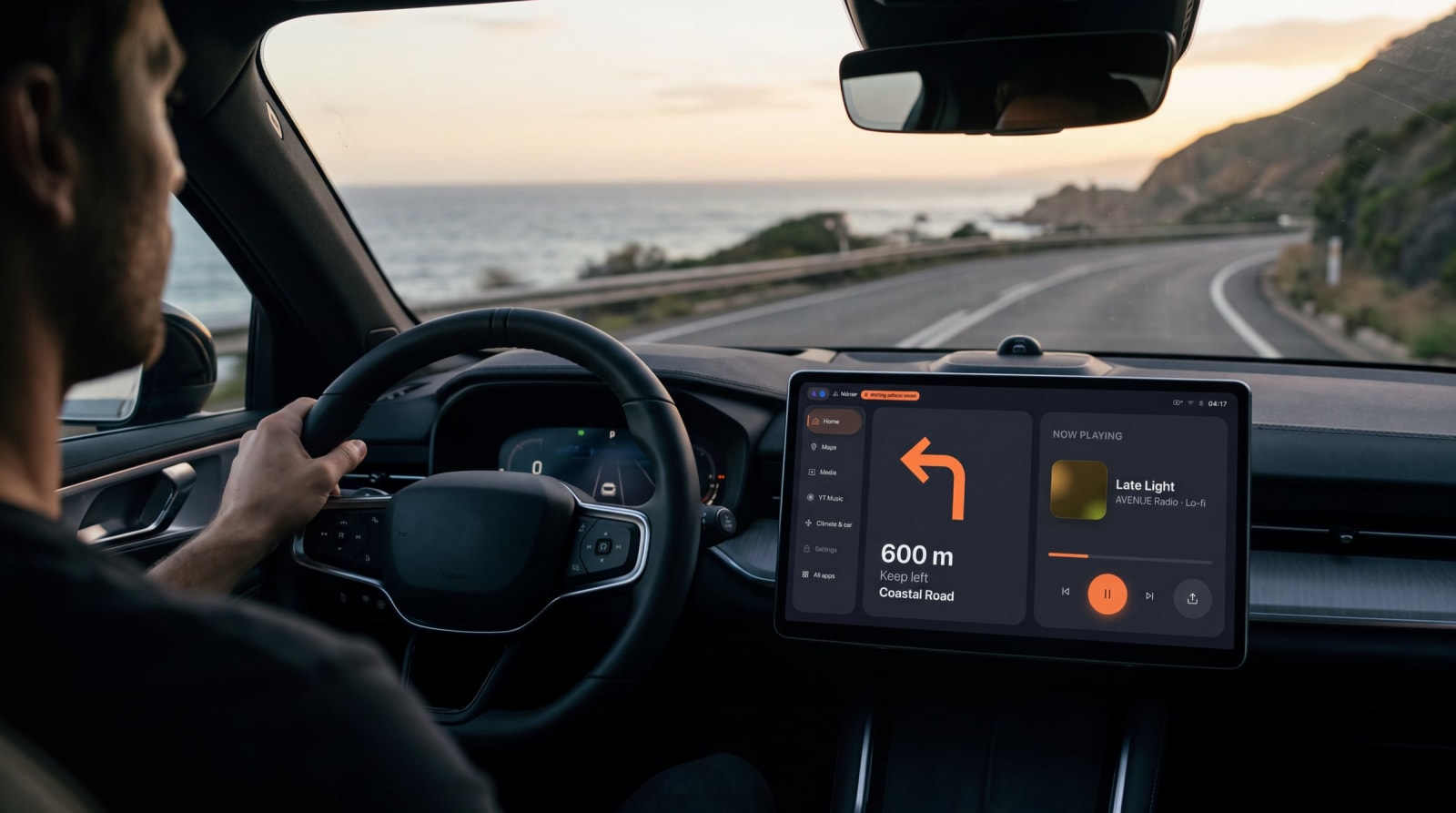
Each seat gets a mode of its own. The driver's screen is for glances: big targets, short tasks, voice and wheel controls first. The co-pilot is the navigator: route, media and the car. The rear seats are lounges: films, music, the route and their own climate zone, for the long part of the journey.
Every screen reads the same state, so nothing is designed for one screen alone, and climate, routines, places and what is playing stay in step across the cabin.

04
Sharing, with consent
A seat can send what is playing, a place or a memory clip to any other seat. The co-pilot finds a film for the long stretch and sends it to the back; the rear passenger sees who sent it and chooses Play here or Not now. Nothing takes over a screen uninvited, and video sent to the driver waits until the car is parked.

05
Calm for the driver
A whole-car system puts a screen in front of the driver, so distraction is the first question. While the car moves, the driver's screen locks video, long text, typing and the AR view, grows its targets to 76 px and shrinks to two tiles: the next turn and what is playing. Everything else goes to voice, the wheel controls or another seat, and a locked item always says why.
The driver mode is designed to NHTSA's visual-manual distraction guidelines: single glances of two seconds or less and twelve seconds in total per task. These are design decisions, not yet test results; the glance test is part of any pilot. SOS works from every seat, with five seconds and one large Cancel before the call is placed.

06
Design system
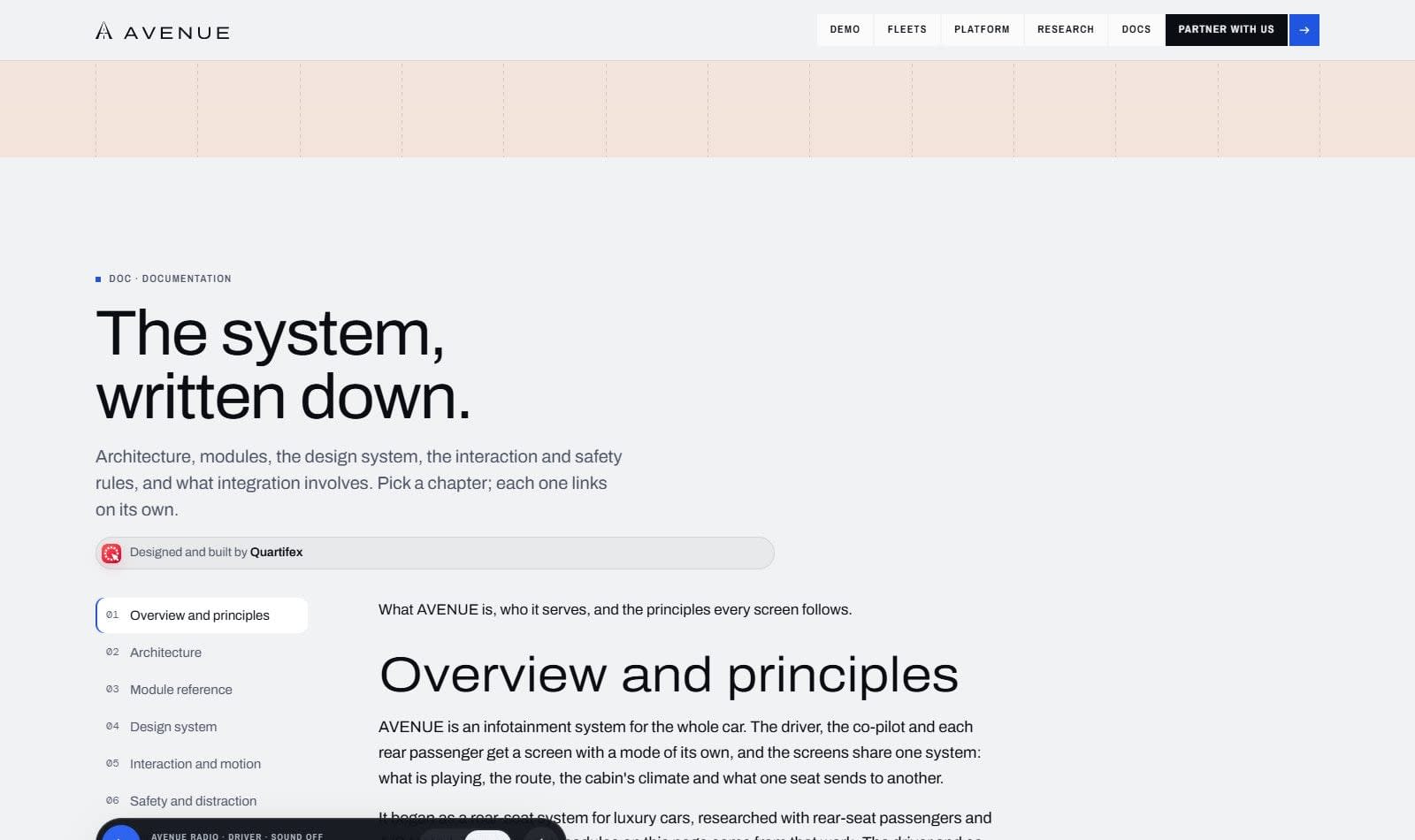
The high-fidelity concept used a neumorphic palette. We kept the soft-surface feel and rebuilt it so every text and control meets WCAG 2.2 AA, which neumorphism's low-contrast edges usually fail. Two themes, cabin for night and paper for documentation, one blue accent, red kept for SOS, and Archivo, Instrument Sans and DM Mono with tabular figures.
Everything renders from one tokens file, so the site, the in-car interface and the documentation cannot drift, and a unit test checks every colour pair in both themes.
07
What the A/B test showed
We tested two versions of the rear-seat interface and surveyed participants afterwards. Version 2, the design AVENUE builds on, improved on every measure. The driver and co-pilot modes extend that work and have been researched and tested with users too.
| Measure | Version 1 | Version 2 |
|---|---|---|
| Overall experience | 3.0 | 4.4 |
| Functionality | 2.9 | 4.25 |
| Workflow flexibility | 3.15 | 4.15 |
| Information hierarchy | 3.15 | 3.9 |
| Clarity and control | 3.0 | 4.15 |
| Mental effort | 3.25 | 2.15 |
| Physical effort | 3.0 | 2.25 |
Survey ratings out of 5. For mental and physical effort, lower is better.
08
The live demo
avenue.quartifex.com drives a 3D car into its own cabin as you scroll, then hands you the system: take any seat, park or drive, send a film to the back, switch to cab mode for a rider's screen. Every screen is real, and everything works from the keyboard. AVENUE is offered to carmakers, mobility start-ups, Tier-1 suppliers and fleet operators as a design-system licence, a co-developed pilot or a custom adaptation.
Try the live demo